The Next Agricultural Revolution
Arriving in the small farming village on the outskirts of Kisumu near the shores of Lake Victoria
in Kenya, Karsten Temme, Chief Innovation Officer of Pivot Bio, followed the local protocol for
visitors: first you introduce yourself to the local elder. They decide what you see, who walks with
you, and how fast.
Temme had come to the village after giving a talk at the TED Countdown Conference in Nairobi,
eager to visit a research team running a trial of the company’s PROVEN 40 microbial nitrogen
technology across 500 farms at the time. After introductions, he joined in behind the elder and
the researchers and matched their pace through the village, stopping at a few plots along the
way. At the end of one road, they reached the elder’s own field — and that’s when everybody
stopped.in behind the elder and the researchers and matched their pace through the village,
stopping at a few plots along the way. At the end of one road, they reached the elder’s own field
— and that’s when everybody stopped.in behind the elder and the researchers and matched
their pace through the village, stopping at a few plots along the way. At the end of one road,
they reached the elder’s own field — and that’s when everybody stopped.
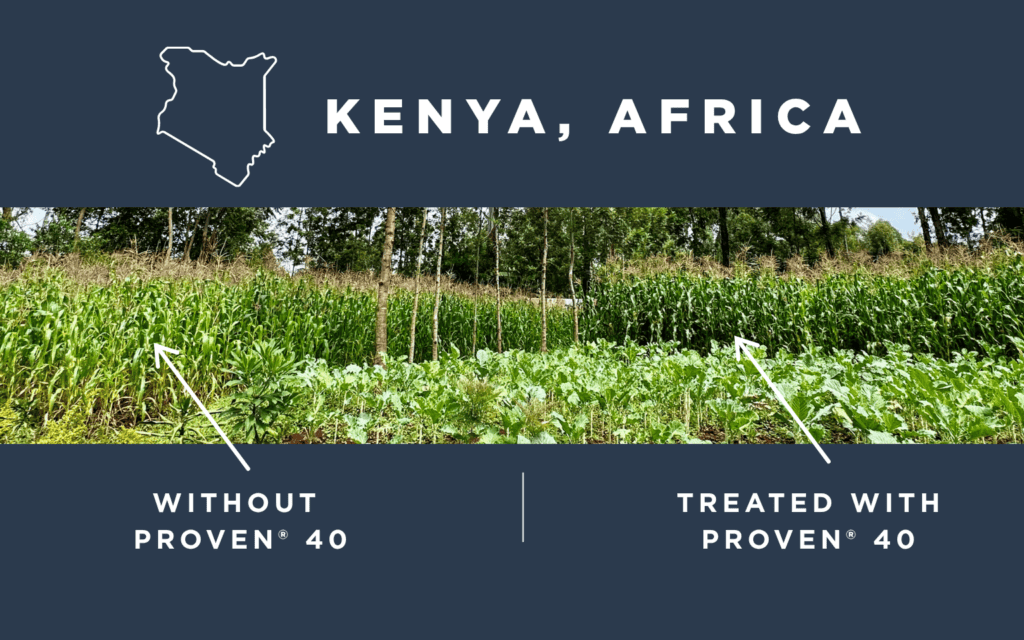
The split was as stark as a before-and-after photograph. On one side: a wall of corn, tall and
dense and almost aggressively green, the kind of uniform, healthy stand that looks like it came
right from central Iowa. On the other: a planting two to three feet shorter, sickly and yellow-
green. The difference between the two halves was not land, rain or labor. It was microbes.
“Everybody said, hold on,” Temme recalled. As the elder walked through the good corn —
touching the stalks, showing them off — the whole group pulled out their phones and started
taking pictures. The invisible line between treated and untreated seed had written itself legibly
into the landscape. Temme got back to his hotel that night and started texting his team back at
Pivot Bio, describing the impact of their product in a small village 8,000 miles away. It’s the kind
of moment that doesn’t show up in the graphs and charts of a research paper.
A few days earlier, Temme had stood before a packed room at the TED Countdown Conference
in Nairobi and made the case for exactly this kind of transformation. His audience — business
leaders, policymakers and nonprofit leaders from across Africa — listened as he described the
forces holding back the continent’s smallholder farmers: a lack of capital, industrial
infrastructure, and transportation networks that had long starved their fields of the synthetic
nitrogen fertilizer available to farmers almost everywhere else in the world. The solution he
proposed was not to build new road systems or chemical plants, but to use a naturally occurring
soil microbe that had been coaxed to fix atmospheric nitrogen directly on the roots of corn
plants. The speech had landed. But Temme knew that true change happens not in conference
rooms, but in fields. The farmers have the last say.
For more than a century, feeding the world has meant building some of the most complex
industrial infrastructure ever conceived. The Haber-Bosch process — the chemical reaction that
pulls nitrogen from the atmosphere and fixes it into synthetic fertilizer — requires facilities so
massive, so energy-intensive, so capital-dependent that they’ve come to define the geography
of modern agriculture itself. If you can’t get fertilizer, or can’t afford it, or can’t transport it to the
last mile of a dirt road, African farmers can‘t produce enough yield to be globally competitive.
“A lot of times, fertilizer is the thing that gets left on the chopping block,” Temme said. “If the
infrastructure doesn’t exist to transport big, bulky fertilizer somewhere, you may not even have it
available. Without access to that input, the profit gap grows wider each year.”
That’s the trap that millions of smallholder farmers around the world have been caught in for
generations. The Green Revolution — the mid-20th-century explosion of improved seeds,
synthetic fertilizers, and irrigation that saved hundreds of millions from starvation — never really
reached them. It required industrial infrastructure they didn’t have, credit they couldn’t get, and
supply chains that stopped well short of their fields.
The African farmers Temme met were primed for new approaches. For decades, the continent
has embraced new technologies in unexpected ways, often skipping the developmental rungs
that industrialized economies had to climb one by one. Rural communities without electrical
grids have pioneered rooftop solar. Instead of building out landline infrastructure, much of Africa
jumped straight to cellular networks. Mobile phones then enabled mobile money accounts
where traditional banks never existed. The lesson, repeated across sectors: what looks like
disadvantage can, at the right technological moment, become a kind of freedom — the freedom
to pioneer better approaches rather than inherit older ones.
It is precisely this logic that animated Temme’s speech in Nairobi, and that animates Pivot Bio’s
growing partnership with policymakers and smallholder farmers in Kenya and beyond. Instead
of a massive, energy-intensive Haber-Bosch facility, nitrogen-fixing microbes can be produced
in small fermentation tanks like those you’d find in a mid-sized brewery. At a fraction of the
capital expenditure and energy input, Pivot Bio can produce enough microbes to treat hundreds
of thousands of acres of farmland. For small farmers, the product doesn’t arrive in trucks but in a
sachet small enough to hold in one hand. “If you wanted to ship all the nitrogen needs for
Kenya’s corn farmers,” Temme said, “you could put it into a couple of airplanes today.”
The way those microbes reach the field is itself a small story of technological leapfrogging.
Farmers text a local distribution team when they’re ready to plant. The team motorbikes out a
package of microbes in a small cooler along with a tube of sugar water that acts as a binder,
helping the microbes adhere to seeds. The farmer mixes the microbes into the sugar water,
shakes the seeds in the jar, and plants by hand. The whole process can be completed in a day.
With mobile phone access widespread across Africa, even smallholder farmers can request
microbial nitrogen on demand.
Temme acknowledges that nitrogen is only one link in a chain of constraints that have kept so
many smallholder farmers locked out of prosperity for generations. What excites him — and
what he talked about at length during a recent call with a Kenyan farming cooperative — is the
possibility that several of those links are breaking simultaneously, right now, for the first time.
Microfinance has expanded the credit infrastructure available to rural communities. A new
generation of Kenyan entrepreneurs — many of them TED attendees Temme met in Nairobi —
are building the logistics and distribution networks that could finally solve the last-mile problem
for agricultural inputs and for the cash crops those inputs help produce. And on the horizon is
the possibility of AI-powered agronomic advice delivered via smartphone, putting the equivalent
of an experienced agronomist in the pocket of every farmer.
“Maybe the finance challenge is starting to get solved, and the ability to get your small holding in your own name in Kenya is starting to become a real thing,” Temme said. “Now we’re going to
be able to get these smallholders in a spot where they have access to credit markets — and
then you have access to digital technology so information and knowledge can flow around the
world faster.”
The vision Temme sketched is of three things arriving together: a new financial environment, a
new alternative to synthetic fertilizer, and digital tools that democratize knowledge. Any one of
those alone is incremental. All three at once would be a step-change toward a higher-
performing, more resilient agricultural system that provides economic empowerment for farmers.
Although Pivot Bio currently has no direct on-the-ground presence in Kenya, it is at the
beginning of what it hopes will be a transformative partnership with African agricultural
stakeholders. The path to scale involves alliances with distribution networks, local agricultural
organizations, and philanthropic funders. None of that is simple.
But the microbes are working. The village elder’s corn is growing. And in farming communities
across western Kenya, word is spreading the way important agricultural news has always
spread — farmer to farmer, field to field.
“A few villages away from the ones that tested our product in these studies, they already knew
about these microbes and they wanted to know where to go buy them,” Temme said. “Word
was spreading like wildfire around the communities about this new medicine for the seeds that
changes everything.”